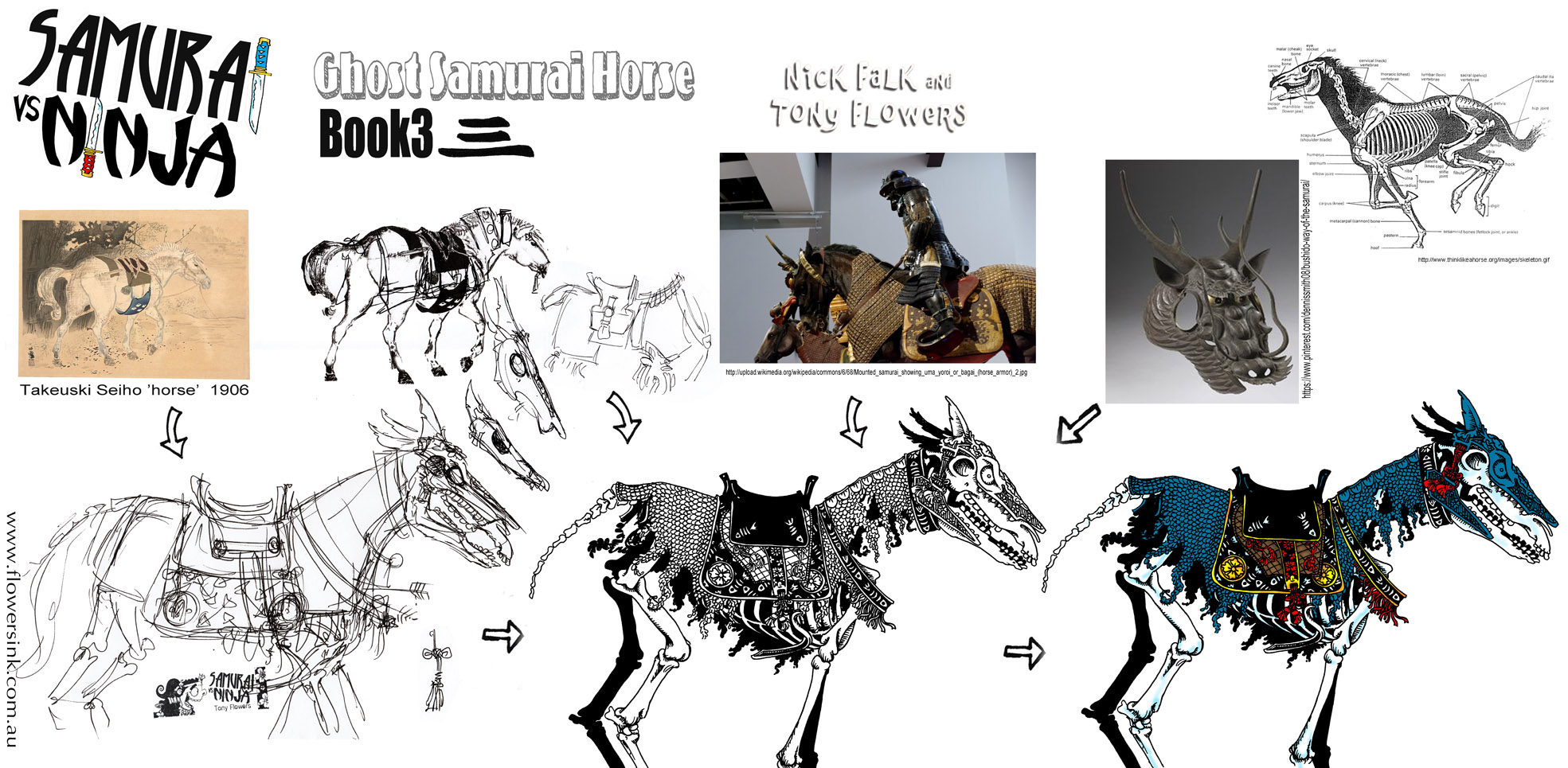
• i have been working through the last chapters for book 3 in the Samurai vs Ninja book series. One of the main characters appears on a ghost battle horse, ready to charge down a hill into battle. Below are some of my research images and sketches to create the battle horse character. Chp9 Horse image rsearch smf

    The finished image as it will appear in the book (below). This image was created using the horse illustration (above), a separate illustration for the ghost Samurai, another for the back ground, another for the speech buble and another to create the pattern for the fishbone border.Samurai vs Ninja bk 3 chp 9

  • Samurai vs Ninja books released by Random House Australia on the 1st of April 2015.
    Samurai vs Ninja books released by Random House Australia on the 1st of April 2015.
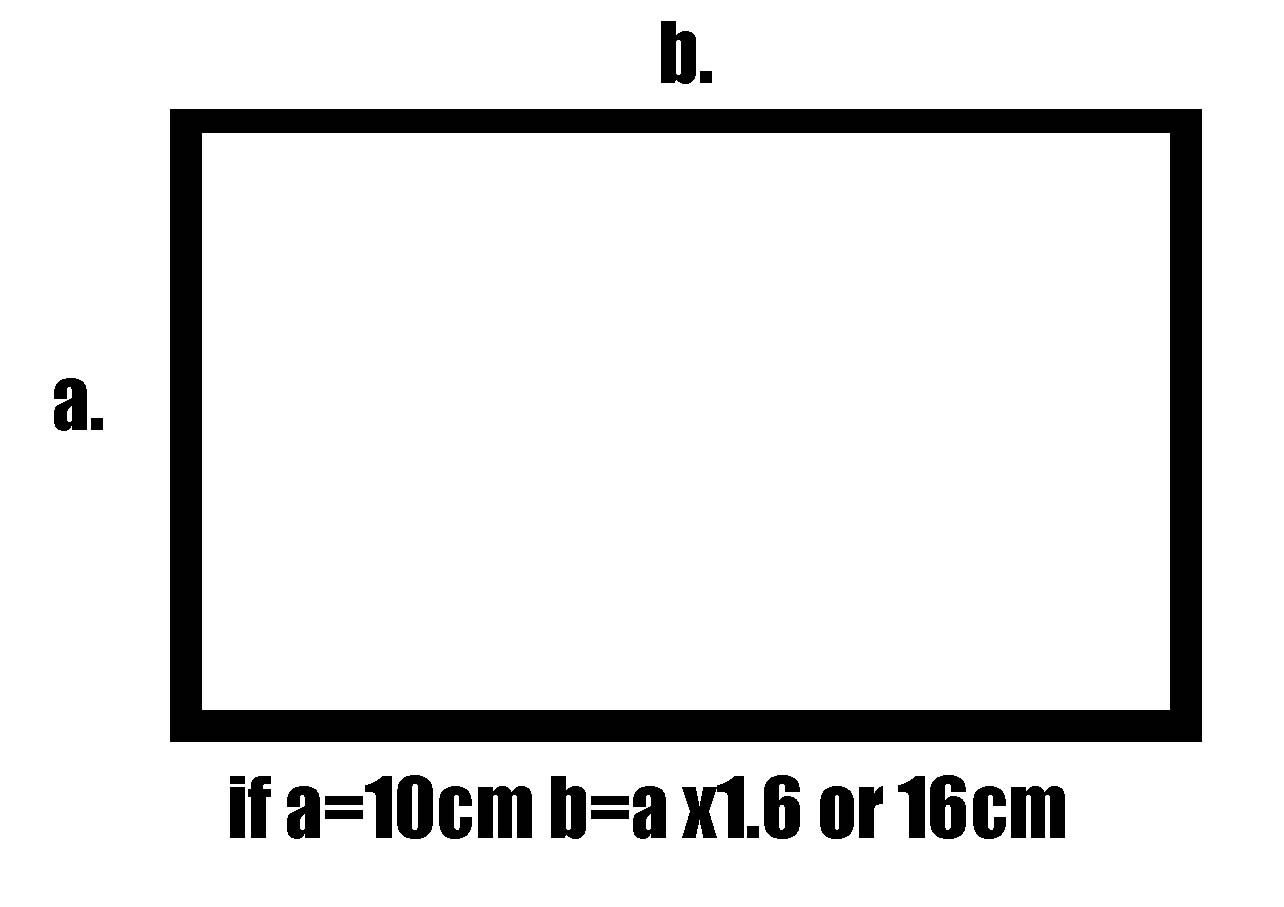
  • When planning an illustration there are many composition theories that can be applied. One of my favourite is ‘the Golden Ratio’. Some times referred to a ‘Di Vinci’s Golden Section’ or ‘Golden Spiral’. That is Leonardo Di Vinci not the Mutant Ninja Turtle. “The Golden Proportion is considered as the most pleasing to human visual sensation and not limited to aesthetic beauty but also be found its existence in natural world through the body proportions of living beings, the growth patterns of many plants, insects and also in the model of enigmatic universe” (Akhtaruzzaman & Shafie 2011) BK2 p 66 and 67 Battle image web This image from book 2 of the Samurai vs Ninja series is based on a double ‘Golden Ratio’ spiral composition. Calculating the Golden Ration is very involved and there numerous complex mathematical models are available in print or online. But to keep it simple the ration roughly works out as 1:1.6. This works a grid of rectangles is formed based on the short length of the rectangle being multiplied by 1.6 to give the longer length. Golden Ratio grid 2 MAR2015 Once you had one grid calculated it is simp a mater of ceasing a series of rectangles that for a grid pattern. Golden Ratio grid 1 MAR2015 Each of the intersection or grid line form strong focal points in an illustration. A spiral can be plotted through the intersecting lines. BK2 p 66 and 67 Battle image web In this diagram you can see the spirals have been overlaid on the grids and I have rotated the 1st grid (and spiral) 180 degrees to create a complimentary balance from one page to the next. BK2 p 66 and 67 Battle image explained web The resulting focal point and elements of the illustration that imply the spiral as shown above. So why have I bother to use this technique in such detail? This image is printed in black and white on a small page. I wanted to give a scenes of chaos while maintaining easy readability. The section of battle on the left hand page is cluttered and the characters body become merged together. I have used the spiral to guide the readers eye into the image. On the right hand page I wanted the battle to focus on the fight between the 2 main characters (brothers) Buta-sama and Kingyo-sama. The centre of this spiral leads down to the clash of their weapons. As the spirals are arranged in this way. the eye of the reader is guided form one spiral to the other in an endless loop. For more in-depth reading on he subject I recommend looking at Akhtaruzzaman,Md & Shafie, A.A, 2011.Geometrical Substantiation of Phi, the Golden Ratio and the Baroque of Nature, Architecture, Design and Engineering, International Journal of the Arts, 1(1), p1-22

  • I have recently began a PhD in design at the University of Canberra, looking at the role of visual literacy in emerging reader chapter books.

    The purpose of my study will be to investigate visual literacy from the perspective of the creators of illustrated works. From my initial readings on the topic of visual literacy, it is normally tackled by educators and literature experts. While this is highly appropriate, a unique perspective on the subject can be gained by discussing visual literacy with the people who create it.

    Books that are narrative driven by text and illustrations occupy a unique phase of in a student’s journey to literacy. The transition from first concept books to pictures books then onto illustrated chapter books can set a student onto a path of life long reading.  As a professional illustrator my work is primarily in the area of emerging reader chapter books for 8 to 12 year olds. I feel that this a very important stage in the reading journey and that through greater understanding we can support children both learn to read and develop a love of books and literature.

    While I have access to limited research funds, I am alway looking for more opportunities. One of which is a ‘Big Ideas – pitch for funding’ run through the University. I will have 3 minutes to explain my research proposal and the reason it is relevant and deserves funding. Unlike most of my other presentations, where I can draw illustrations or show an avalanche of images. I am limited to a single image to support my concept. below is my book bridge image for the presentation.
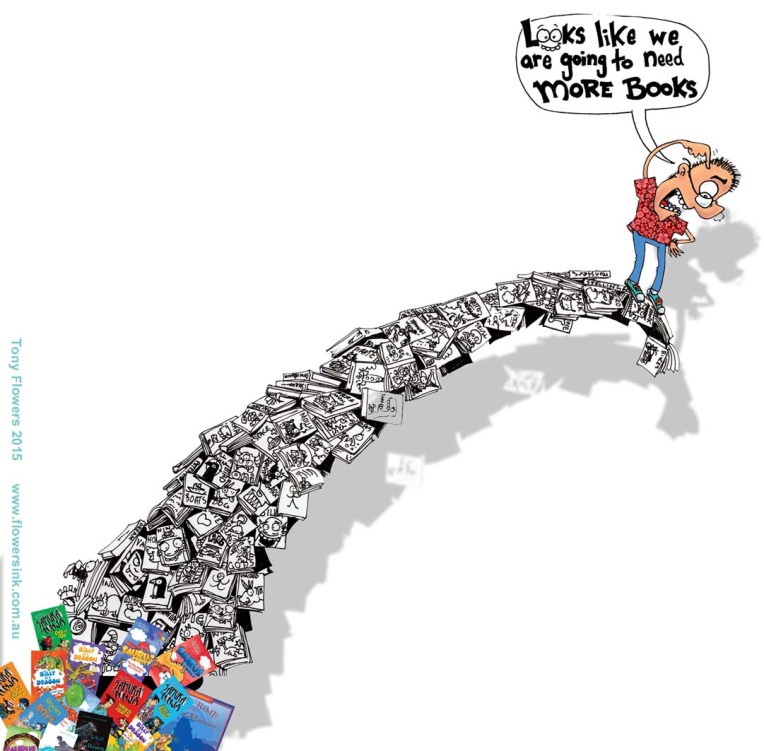
    Big Ideas Pitch image Tony Flowers 2015 smf

    I am hoping that the pitch will be successful and I receive some extra funding to assist with my research expenses. It is my aim that this research will have a practical out come, giving teachers resources to draw upon for a more in depth understanding of an illustrators work practices and the visual narrative devices they construct. Enhancing their ability to utilise illustrated works in supporting a student’s development of visual and text based literacy skills.

    Please feel free to contact me at tony@flowersink.com.au if you are interested in my research area.

    Tony Flowers
  • I am immersed in the very silly world of Samurai vs Ninja. Currently working on images for books 3 and 4. This guy is my suggested image for the back cover of book 3.

    Ghost Ninja
    Ghost Ninja

    He reminds me a little of myself at the moment. Not only am I working on several publishing projects at the moment I have started a PhD at the University of Canberra. I hope to become a Doctor of Silly Drawings! This should keep me out of trouble for a few years.

  • Samurai vs Ninja book
    Samurai vs Ninja book

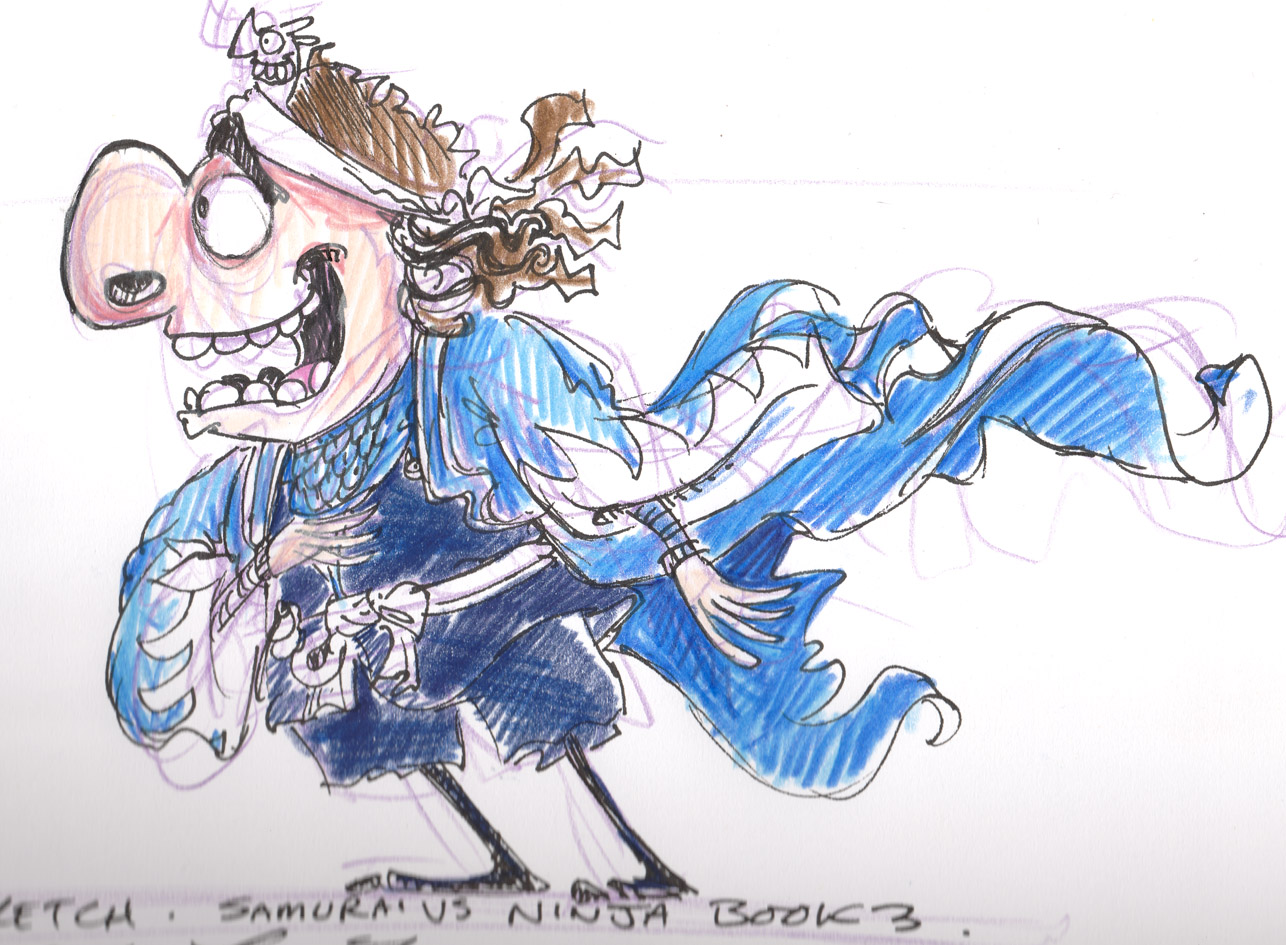
    BK3 Buta sketch 2These are a few early concept ratings for Buta sama for book  in the Samurai vs Ninja series. I am trying out a new cloak for Buta to wear to a festival event. I am liking it so far as I also get to play with it in a very Batman cape kind of way.

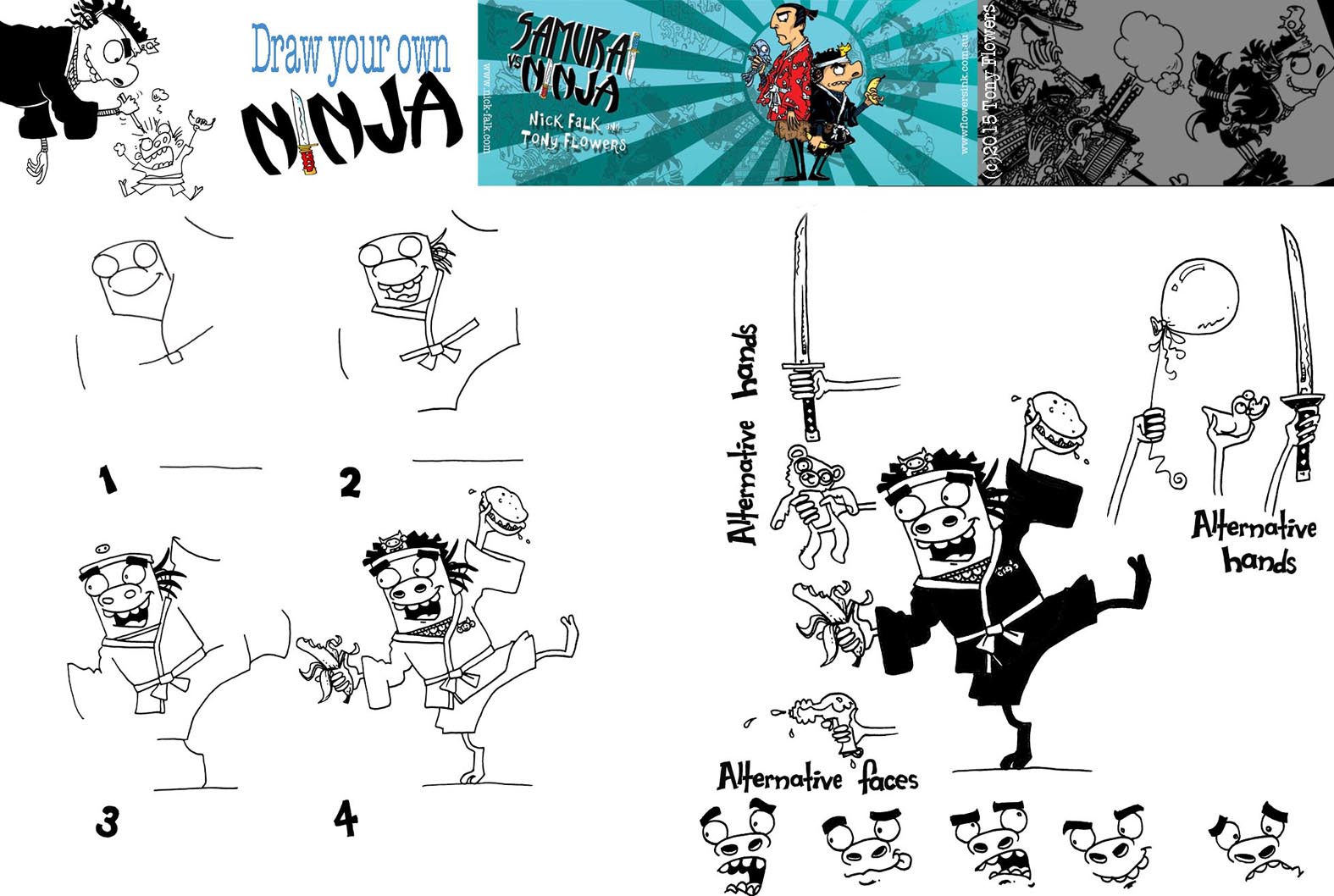
  • This is a basic step by step guide on how to draw a ‘Ninja’ in the style of the Samurai vs Ninja books. Feel free contact me if you would like some steps to other characters from my books.

    Draw your own Ninja sheet

  • This is a simple character sheet for drawing But a same from my up coming series, Samurai vs Ninja. I thought that I would post this my the young and talented budding illustrator c. Have fun practicing in the school holidays.

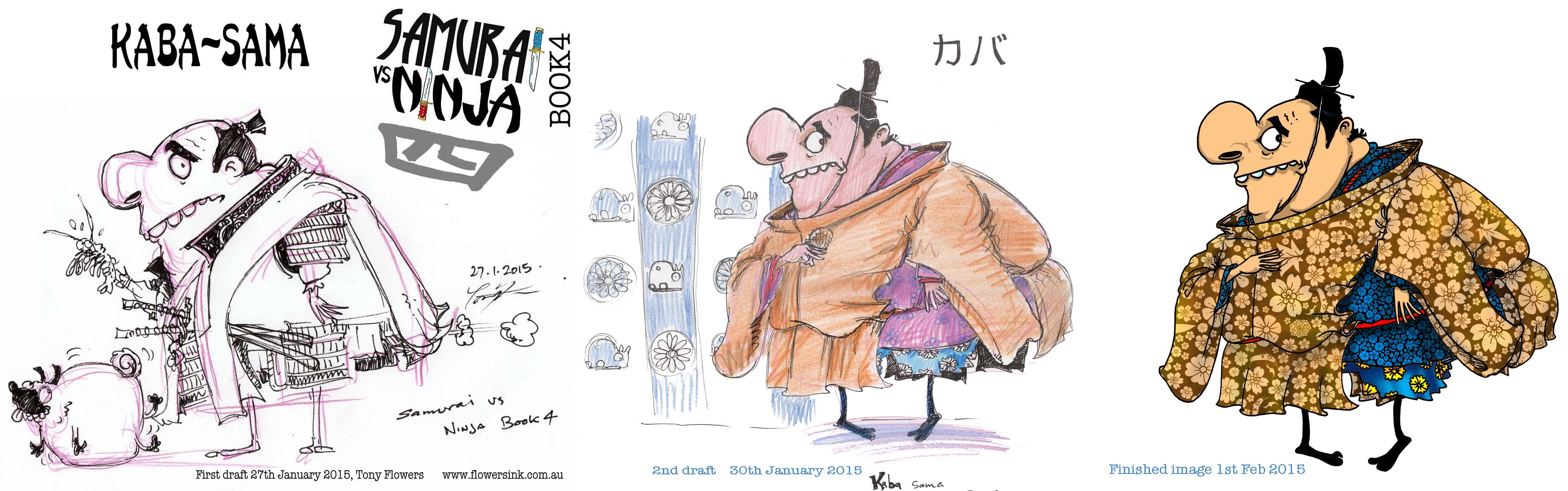
    Sketch to finished art sample Buta sama